




















IT Staff Augmentation vs. Full Outsourcing: The Enterprise Decision Guide 2026
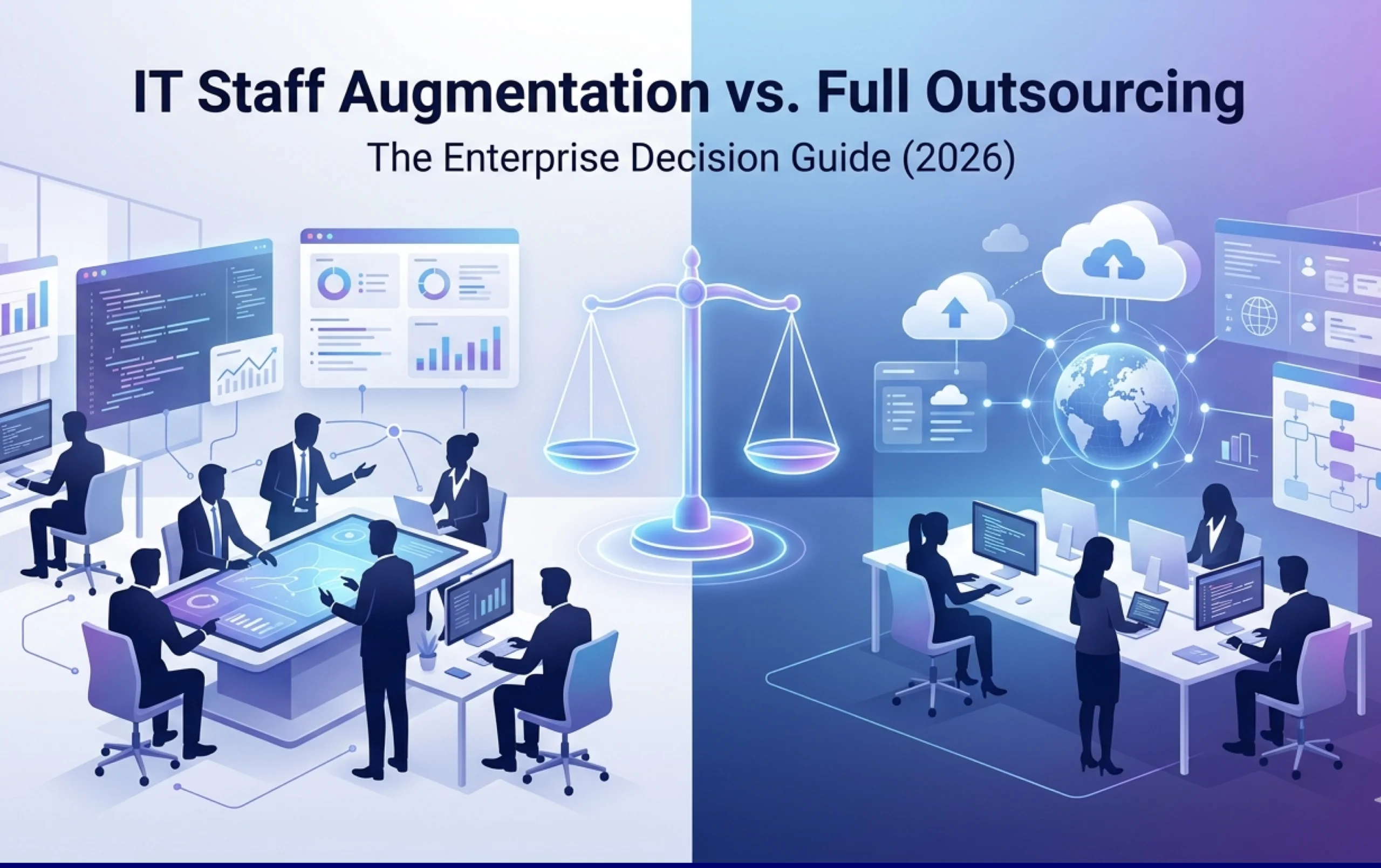
In today’s enterprise IT landscape, choosing the right workforce model is no longer just an operational decision—it’s a strategic lever for scalability, innovation, and cost control.
As organizations accelerate digital transformation, CTOs and CIOs face a critical question:
👉 Should you scale with IT staff augmentation or fully outsource your development?
Both models offer unique advantages—but choosing the wrong one can lead to budget overruns, delivery delays, and loss of control.
This guide breaks down the key differences, cost implications, use cases, and decision frameworks to help enterprises make the right choice.
What is IT Staff Augmentation?
IT staff augmentation is a flexible hiring model where external developers or specialists are integrated into your in-house team.
Key Characteristics:
-
- You retain full control over projects
- External talent works as an extension of your internal team
- Ideal for skill gaps or temporary scaling
Example:
A US-based fintech company hires 5 offshore React developers to support its internal engineering team during peak product development.
What is Full IT Outsourcing?
Full outsourcing involves delegating an entire project—or even a function—to a third-party vendor.
Key Characteristics:
-
- Vendor manages end-to-end delivery
- Minimal internal involvement required
- Ideal for non-core or standalone projects
Example:
A healthcare enterprise outsources its mobile app development to an external agency with complete ownership.
IT Staff Augmentation vs. Outsourcing: Key Differences
| Factor | Staff Augmentation | Full Outsourcing |
| Control | High (you manage) | Low (vendor manages) |
| Flexibility | Very high | Moderate |
| Cost Structure | Hourly/monthly | Fixed/project-based |
| Scalability | On-demand | Depends on vendor |
| Time to Start | Fast | Moderate |
| Risk | Shared | Vendor-heavy |
| Communication | Direct | Indirect |
👉 Insight: Enterprises that require tight control and agility typically lean toward staff augmentation, while those seeking hands-off execution prefer outsourcing.
Cost Comparison: Which Model is More Cost-Effective?
Cost is often the deciding factor—but the reality is more nuanced.
Staff Augmentation Costs
-
- US developers: $80–$150/hour
- Offshore developers: $25–$60/hour
- Additional cost: management overhead
Outsourcing Costs
-
- Fixed project pricing
- Lower upfront cost visibility
- Risk of scope creep and hidden costs
Key Takeaway:
-
- Short-term projects → Outsourcing is cheaper
- Long-term scaling → Staff augmentation offers better ROI
👉 Enterprises often underestimate the hidden costs of outsourcing, such as rework, communication delays, and vendor dependency.
When to Choose IT Staff Augmentation
Staff augmentation is ideal when:
1. You Need Specialized Skills Quickly
Access niche expertise (AI, DevOps, cybersecurity) without long hiring cycles.
2. You Want Full Control Over Development
Critical for industries like:
-
- Healthcare (HIPAA compliance)
- Fintech (data security)
- SaaS (product iteration speed)
3. You’re Scaling an Existing Product
Perfect for:
-
- MVP → Product scaling
- Feature expansion
- Agile development environments
You Have a Strong Internal Team
Augmentation works best when you already have:
-
- Product managers
- Tech leads
- Established workflows
When to Choose Full Outsourcing
Outsourcing is the better option when:
-
- You Lack Internal Technical Expertise
Ideal for non-tech enterprises launching digital products. - You Want Faster Time-to-Market
Vendors bring pre-built teams and processes. - You’re Working on a One-Time Project
Examples:-
- Website redesign
- Mobile app development
- Legacy system migration
-
- You Prefer Predictable Budgeting
Fixed pricing helps with financial planning.
- You Lack Internal Technical Expertise
Enterprise Decision Framework (CTO-Level)
Use this framework to determine the right model:
Choose Staff Augmentation if:
-
- You need ongoing development
- You require tight control
- Your product is core to business success
- You follow Agile methodologies
Choose Outsourcing if:
-
- The project is non-core
- You lack internal resources
- You want end-to-end delivery
- You prefer minimal involvement
Hybrid Model: The Emerging Enterprise Trend (2026)
Modern enterprises are increasingly adopting a hybrid approach:
👉 Combine staff augmentation + outsourcing
Example Strategy:
-
- Core product → Staff augmentation
- Secondary modules → Outsourced
Benefits:
-
- Cost optimization
- Faster delivery
- Reduced risk
- Increased flexibility
This model is gaining traction due to:
-
- Remote workforce expansion
- AI-driven development
- Global talent access
Risks and Challenges (And How to Mitigate Them)
Staff Augmentation Risks
-
- Communication gaps
- Dependency on internal management
- Cultural differences
Mitigation:
-
- Strong onboarding processes
- Clear KPIs
- Agile collaboration tools
Outsourcing Risks
-
- Loss of control
- Quality issues
- Vendor lock-in
Mitigation:
-
- Clear SLAs
- Milestone-based delivery
- Regular audits
Real-World Use Cases
Use Case 1: SaaS Company Scaling Product
-
- Model: Staff Augmentation
- Outcome: Faster feature releases, better control
Use Case 2: Healthcare App Development
-
- Model: Outsourcing
- Outcome: Faster launch, reduced internal workload
Use Case 3: Enterprise Digital Transformation
-
- Model: Hybrid
- Outcome: Balanced cost + scalability
Staff Augmentation vs Outsourcing: Final Verdict
There is no one-size-fits-all answer.
👉 The right choice depends on:
-
- Business goals
- Project complexity
- Internal capabilities
- Budget constraints
Quick Summary:
-
- Choose Staff Augmentation → Control, scalability, long-term growth
- Choose Outsourcing → Speed, simplicity, short-term execution
- Choose Hybrid → Best of both worlds
🚀 Why Enterprises Choose Kernshell for IT Workforce Solutions
At Kernshell, we help enterprises move beyond the “either/or” dilemma.
What Sets Us Apart:
-
- 8+ years of enterprise IT expertise
- Pre-vetted global talent pool
- Flexible engagement models
- Strong focus on security and compliance
- Seamless integration with your workflows
We don’t just provide developers—we deliver scalable engineering capacity aligned with your business goals.
In 2026, the enterprises that win are not the ones with the biggest teams—but the ones with the most flexible and scalable workforce strategies.
Choosing between IT staff augmentation and outsourcing isn’t just about cost—it’s about building a future-ready organization.
This article was originally published on the Kernshell blog. Read the full version on Medium: IT Staff Augmentation vs. Full Outsourcing: The Enterprise Decision Guide