




















Sitefinity vs Sitecore: Enterprise Migration Guide
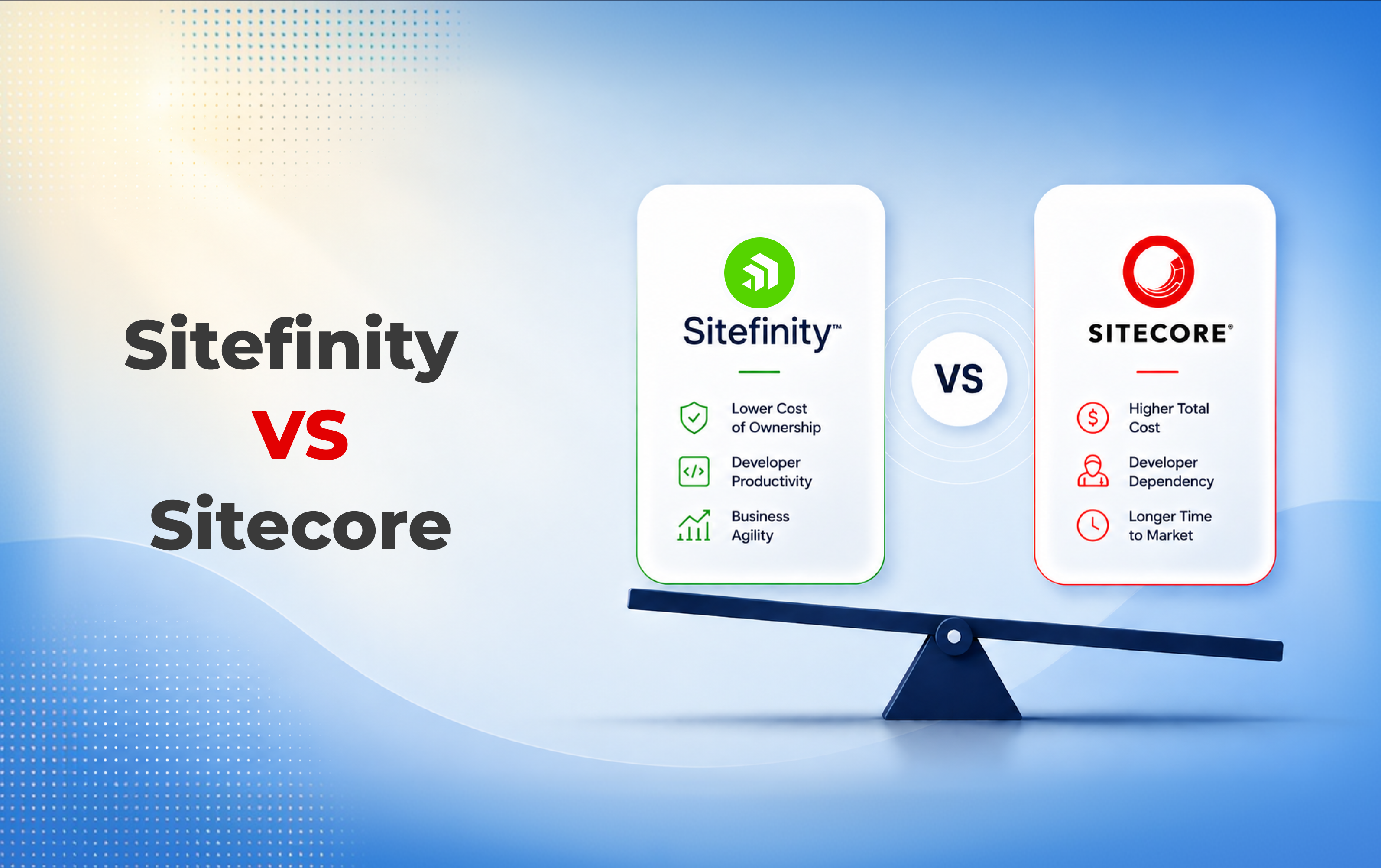
For many enterprise organizations, the decision to move from Sitecore is not made lightly. Sitecore has been the gold standard of enterprise digital experience platforms for over two decades. But in 2026, a growing number of IT and marketing leaders are reaching the same conclusion: the platform’s complexity, licensing costs, and steep developer dependency have become structural liabilities — not investments.
Sitefinity has emerged as the most direct enterprise-grade alternative. This guide compares both platforms honestly, examines the real costs of each, and provides a practical migration roadmap for organizations considering the switch.
Why Enterprises Are Migrating from Sitecore to Sitefinity in 2026
Sitecore’s market position has shifted. Its mindshare in the DXP category dropped from 7.0% to 5.1% between 2024 and mid-2025 on PeerSpot, while Sitefinity’s grew from 1.2% to 3.3% in the same period. The reasons organizations are making the switch are consistent:
The Real Cost of Sitecore: Licensing, Infrastructure & Total Staffing
Sitecore’s licensing model is notoriously opaque — final pricing requires a custom quote, and total cost of ownership frequently surprises first-time buyers. Based on 2026 benchmark data from Vendr and Appverticals, a mid-market Sitecore deployment carries a 3-year TCO of $450,000 to $825,000 — covering licensing, Azure hosting, specialist developer costs, and the overhead of maintaining a complex platform that marketing teams cannot operate independently.
Sitefinity’s equivalent 3-year TCO is typically 40–55% lower, driven by more accessible licensing, Sitefinity Cloud’s managed infrastructure, and a marketer-friendly interface that reduces dependence on developers for routine content updates.
Why Sitecore’s Complexity Hurts Marketing Team Productivity
G2 reviews from 2025–2026 give Sitefinity an 8.1/10 ease-of-use rating versus Sitecore’s 7.0/10. Sitefinity’s overall user satisfaction rate is 80% compared to Sitecore’s 68%. The practical impact: marketing teams operating Sitefinity can execute campaigns, update personalization rules, and publish new content without frequent developer involvement. On Sitecore, even routine content changes often require developer queues, slowing campaign velocity and increasing operational overhead.
Sitefinity vs Sitecore: Feature-by-Feature Comparison
|
Feature |
Sitefinity |
Sitecore |
Edge |
|
Ease of use (G2) |
8.1 / 10 |
7.0 / 10 |
✅ Sitefinity |
|
Mobile capabilities (G2) |
Higher rated |
Lower rated |
✅ Sitefinity |
|
Analytics & Audience Insight |
Higher rated |
Lower rated |
✅ Sitefinity |
|
Personalization depth (G2 score) |
Strong (9.1) |
Very strong |
✅ Sitecore (enterprise scale) |
|
Developer tooling (G2) |
Strong |
9.2 / 10 |
✅ Sitecore (bespoke builds) |
|
Headless / API-first |
REST, GraphQL, Next.js |
XM Cloud, JSS |
Comparable |
|
Multisite & multilingual |
Built-in, intuitive |
Available, complex setup |
✅ Sitefinity |
|
Cloud-managed hosting |
Sitefinity Cloud (Azure) |
XM Cloud (Azure) |
Comparable |
|
ROI payback period |
22 months avg. |
29 months avg. |
✅ Sitefinity |
|
License cost |
Lower, transparent |
High, custom quote |
✅ Sitefinity |
Headless CMS: Sitefinity vs Sitecore XM Cloud
Both platforms support headless delivery in 2026, but through meaningfully different architectures. Sitecore XM Cloud is a fully SaaS, cloud-native headless platform using the JavaScript Services (JSS) framework and a composable DXP model. It’s powerful but requires dedicated front-end expertise and imposes significant architectural changes on organizations migrating from traditional Sitecore XP installations.
Sitefinity’s approach is a “hybrid headless” model — the platform can operate simultaneously as a traditional CMS (with WYSIWYG page editing) and as a headless backend (delivering content via REST/OData and GraphQL APIs to Next.js or React renderers). This hybrid approach is especially valuable for organizations that want modern frontend performance without forcing all content teams to abandon familiar editing workflows.
Total Cost of Ownership: Sitefinity vs Sitecore (3-Year TCO)
|
Cost Category |
Sitefinity (3-Year) |
Sitecore (3-Year) |
| Platform licensing |
$60,000 – $120,000 |
$150,000 – $300,000+ |
| Cloud hosting & infrastructure |
$30,000 – $60,000 |
$60,000 – $120,000 |
| Implementation & customization |
$100,000 – $200,000 |
$150,000 – $300,000 |
| Ongoing developer support |
$40,000 – $80,000 |
$100,000 – $200,000 |
| Training & change management |
$10,000 – $20,000 |
$20,000 – $40,000 |
| Estimated 3-Year TCO |
$240,000 – $480,000 |
$480,000 – $960,000 |
Key Insight: Organizations migrating from Sitecore to Sitefinity typically recover the migration cost within 14–22 months through lower licensing, reduced developer dependency, and faster content publishing cycles. Sitefinity’s average ROI payback of 22 months compares favorably to Sitecore’s 29-month average.
How to Migrate from Sitecore to Sitefinity: Step-by-Step
Phase 1: Content Audit and Migration Scoping (2–4 weeks)
Before any technical work begins, run a full audit of your Sitecore instance: total page count, content types, templates, custom components/renderings, third-party integrations, personalization rules, and media assets. This scoping phase determines the migration budget and timeline more accurately than any estimate made without it. Several Sitefinity partners offer specialized assessment tools for Sitecore-to-Sitefinity migrations that produce structured scope reports before any commitment.
Phase 2: Architecture Design on Sitefinity (3–5 weeks)
Map Sitecore’s content model to Sitefinity’s content types, dynamic modules, and page templates. Decide on deployment model: Sitefinity Cloud (recommended for most enterprises), on-premise, or hybrid headless with a Next.js frontend. Design the multisite and multilingual structure if applicable. Plan the integration architecture for CRM, ERP, marketing automation, and analytics connections.
Phase 3: Development, Content Migration & Integration (6–20 weeks)
Build custom Sitefinity widgets and templates. Execute content migration — automated tools can handle structured content; rich text, complex layouts, and custom renderings typically require manual review. Complete API integrations. Configure Sitefinity Insight for analytics and personalization segments. Run parallel environments (Sitecore live, Sitefinity staging) to allow QA without business disruption.
Phase 4: Go-Live and Post-Migration Optimization (2–4 weeks)
Execute DNS cutover and monitor for any broken redirects, missing content, or integration failures. Ensure 301 redirects are correctly set from all legacy Sitecore URLs to preserve SEO equity. Train content teams on Sitefinity’s editor interface. Establish baseline performance metrics to measure improvement against Sitecore benchmarks.
When Sitecore Is Still the Right Choice
This guide would be incomplete without acknowledging where Sitecore genuinely holds an advantage. If your organization requires the absolute deepest level of enterprise personalization at very large scale (millions of monthly sessions with complex behavioral targeting rules), has an existing large team of Sitecore-certified developers, or has made significant recent investments in the Sitecore composable DXP ecosystem (Content Hub, CDP, Personalize), migrating may not justify the disruption costs. Sitecore also holds an edge in raw developer tooling flexibility for highly bespoke, custom-coded implementations. Budget is not a constraint for every enterprise.

This article was originally published on the Kernshell blog. Read the full version on Medium: Sitefinity vs Sitecore: Enterprise Migration Guide