




















Industrial AI 2.0: Predictive Maintenance & The Autonomous Factory Floor
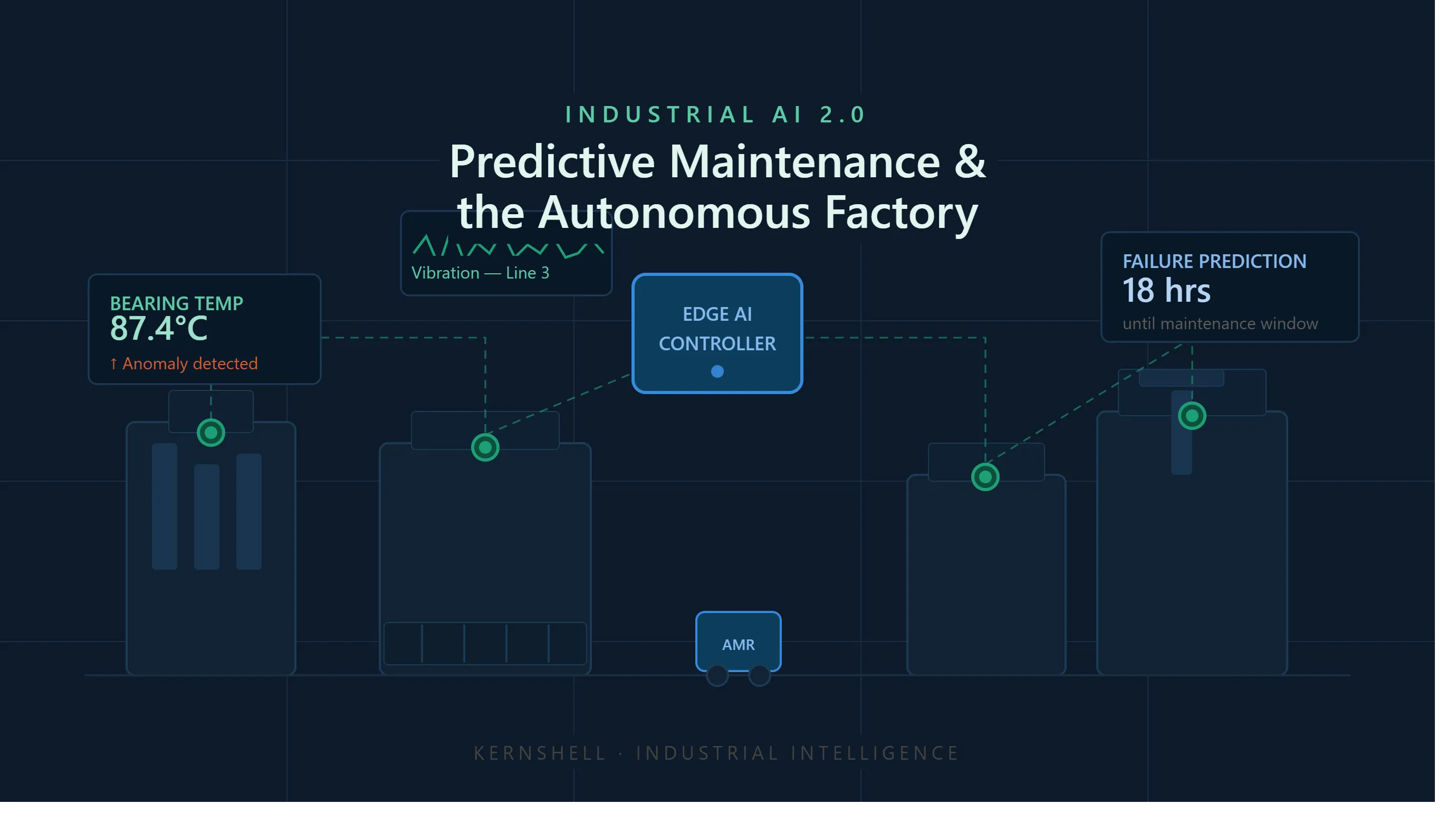
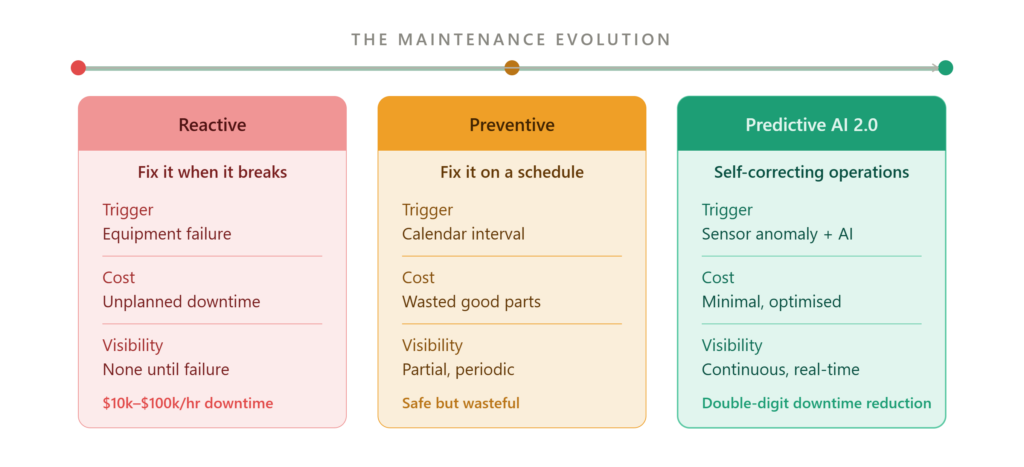
For decades, factory maintenance followed one of two playbooks: fix it when it breaks, or fix it on a fixed schedule whether it needs it or not. Both approaches waste money. Reactive maintenance causes unplanned downtime that can cost manufacturers tens of thousands of dollars per hour. Preventive maintenance, while safer, often replaces perfectly good parts simply because the calendar said so. Industrial AI 2.0 is rewriting this equation entirely, moving factories from scheduled guesswork to predictive certainty – and, increasingly, to autonomous self-correction.
From Predictive Maintenance to Predictive Operations
The first wave of industrial AI focused narrowly on predicting equipment failure. Sensors captured vibration, temperature, and acoustic data; machine learning models flagged anomalies before they became breakdowns. That was a meaningful improvement, but it was still a point solution bolted onto an otherwise unchanged factory floor.
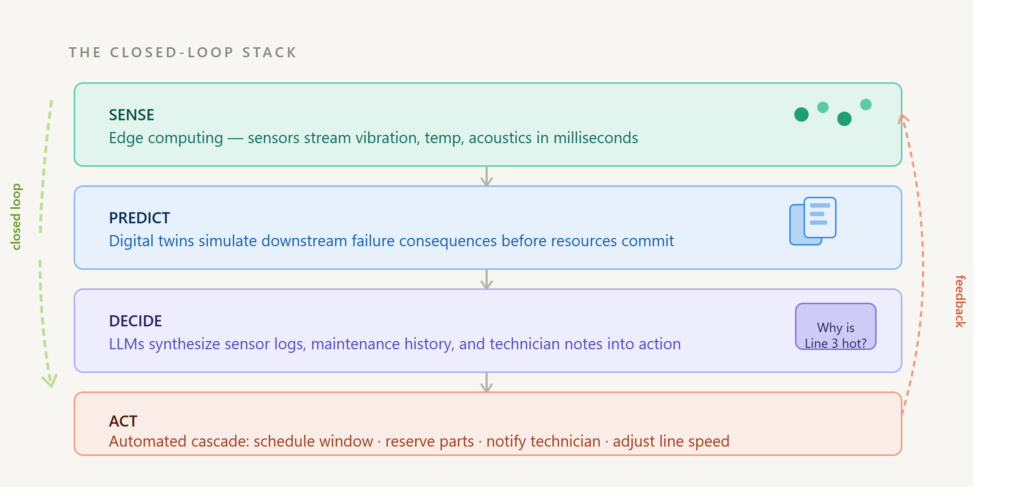
Industrial AI 2.0 is different in scope. It doesn’t just predict when a bearing will fail – it connects that prediction to production scheduling, spare parts inventory, workforce allocation, and energy consumption in real time. A single vibration anomaly on a conveyor motor can now automatically trigger a cascade of decisions: reschedule the maintenance window around the production plan, reserve the replacement part from inventory, notify the technician with the right certification, and adjust downstream line speeds to absorb the change without missing a shipment deadline. This is maintenance as an integrated operations decision, not an isolated engineering task.
The Technology Stack Behind the Shift
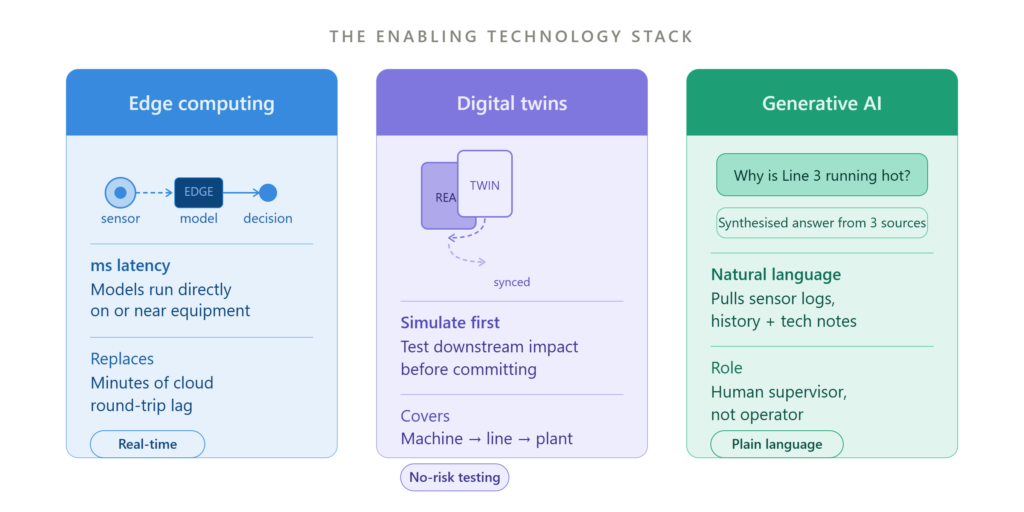
Three developments have made this leap possible. First, edge computing now allows models to run directly on or near equipment, cutting the latency between sensor reading and decision from minutes to milliseconds. Second, digital twins – high-fidelity virtual replicas of machines, lines, or entire plants – let AI systems simulate the downstream consequences of a failure or a fix before committing resources. Third, large language models and multimodal AI now sit on top of these systems, letting a maintenance engineer simply ask, “Why is Line 3 running hot?” and receive a synthesized answer that pulls from sensor logs, maintenance history, and even technician notes written in plain language.
Together, these layers form what’s often called a “closed-loop” system: sense, predict, decide, and act, with a human increasingly positioned as supervisor rather than operator.
The Autonomous Factory Floor Is Arriving in Stages
True lights-out manufacturing – factories running with no human intervention at all – remains rare outside of a handful of highly controlled environments. But the incremental steps toward autonomy are accelerating and already delivering measurable value:
-
- Self-adjusting equipment: CNC machines and robotic arms that recalibrate tool paths in response to detected wear, rather than waiting for a technician to notice drift in part quality.
- Autonomous mobile robots (AMRs): Increasingly coordinated by AI schedulers that reroute material flow around a machine flagged for imminent maintenance, so the line doesn’t stall.
- Generative AI copilots: Deployed on the floor to help technicians diagnose issues, pull up repair procedures, and log root-cause data automatically, cutting mean time to repair.
- Autonomous quality inspection: Computer vision systems that catch defects correlated with equipment degradation, closing the loop between product quality and machine health.
Each of these is a discrete capability today, but manufacturers who integrate them into a shared data layer are seeing something closer to genuine autonomy emerge – not because any single AI system is “in charge,” but because the handoffs between systems have been automated away.
What This Means for Manufacturing Leaders
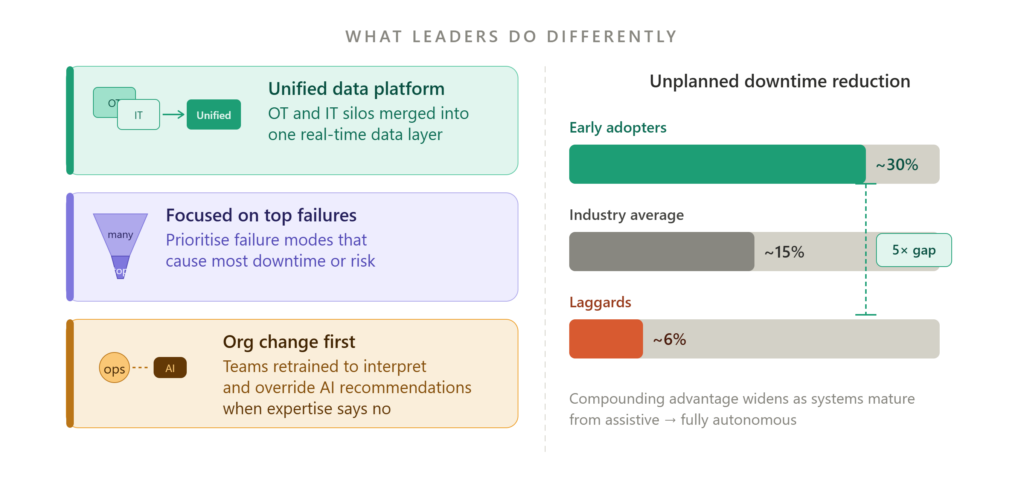
The organizations getting the most value from Industrial AI 2.0 share a few common traits. They’ve invested in unifying their data – OT and IT systems that used to sit in silos are now feeding a common data platform. They’ve resisted the urge to chase every AI use case simultaneously, instead prioritizing the failure modes that cause the most downtime or safety risk. And critically, they’ve treated this as an organizational change as much as a technical one, retraining maintenance teams to interpret AI recommendations and override them when domain expertise says the model is wrong.
The ROI case is no longer theoretical. Manufacturers deploying mature predictive maintenance programs commonly report double-digit reductions in unplanned downtime and meaningful extensions in asset life. As these systems mature into fuller autonomous operations, the gap between early adopters and laggards will widen — not because the technology is exotic, but because the compounding value of a truly integrated, self-correcting factory floor is difficult to catch up to once a competitor has built it.
Looking Ahead
Industrial AI 2.0 isn’t a single product or platform – it’s an architectural shift in how factories sense, decide, and act. Predictive maintenance was the entry point. The autonomous factory floor, built from digital twins, edge AI, generative copilots, and coordinated robotics, is the destination. Manufacturers that start building the data foundation now – clean, unified, real-time – will be the ones positioned to take full advantage as these capabilities mature from assistive to genuinely autonomous.
This article was originally published on the Kernshell blog. Read the full version on Medium: Industrial AI 2.0: Predictive Maintenance & The Autonomous Factory Floor