





Agentic AI in the Enterprise: Moving from Pilot to Production in 2026

Nearly every enterprise has an agent pilot running somewhere right now. Far fewer have one in production, and even fewer are seeing meaningful results from it.
Roughly 80% of enterprise applications shipped or updated in early 2026 embed at least one AI agent, up from a third in 2024, and 40% of applications are expected to carry task-specific agents by year-end. Adoption isn’t the bottleneck. Production is. Multiple 2026 studies from Gartner, Forrester, IDC, and MIT put the share of agent pilots that never reach production somewhere between 77% and 95%, depending on how “production” is defined. Gartner separately expects more than 40% of agentic AI projects to be cancelled outright by 2027.
The gap isn’t a model quality problem. It’s an organizational one — the same handful of scoping, integration, and governance gaps showing up project after project. This post covers what the data says is actually breaking, what the organizations that do reach production have in common, and a practical framework for closing that gap.
The Numbers Behind the Gap
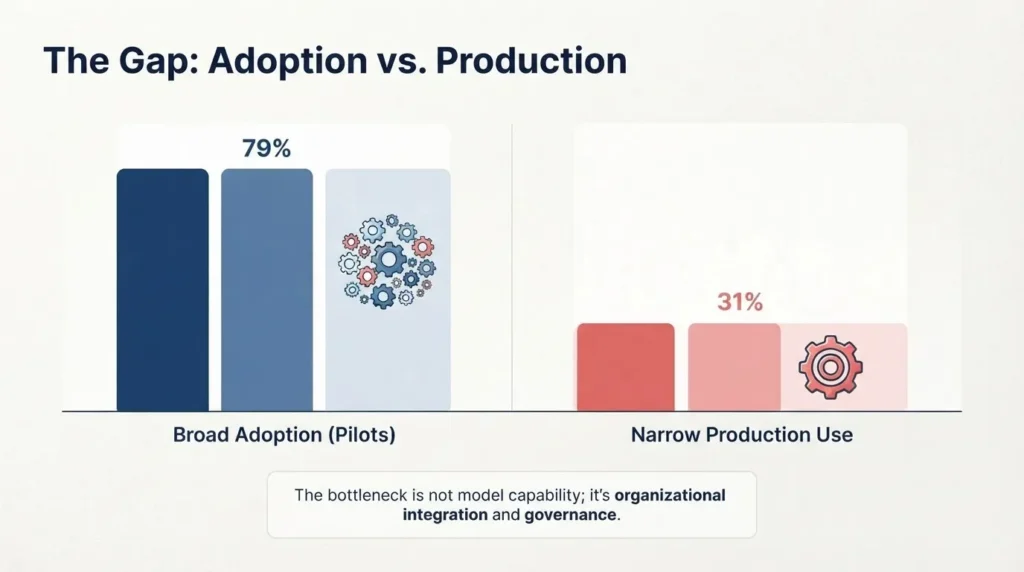
A few figures from 2026 research define the current state clearly:
-
- Adoption is broad, production is narrow: About 79% of enterprises have adopted AI agents in some form; only around 31% run any agent in production, concentrated in banking and insurance (47%) versus healthcare and government (18% and 14%).
- Results come quickly once agents ship: Enterprises typically see agents delivering measurable operational impact within months of launch — sales development agents tend to show results fastest, while finance and operations agents generally take longer to reach the same point.
- Meaningful impact is real, but concentrated: Only a minority of organizations report significant, measurable impact from their agent deployments. Even among deployments that survive a full year, a notable share still fail to deliver the results that justified building them.
- The strongest performers pull ahead by a wide margin: Enterprises with mature deployments report substantially stronger outcomes than the rest of the field, but generally only when success criteria, tool access, and governance were defined before the build started.
The pattern across every study: the failures cluster around the same causes, and none of them are about the underlying model being insufficiently capable.
Why Pilots Stall Before Production
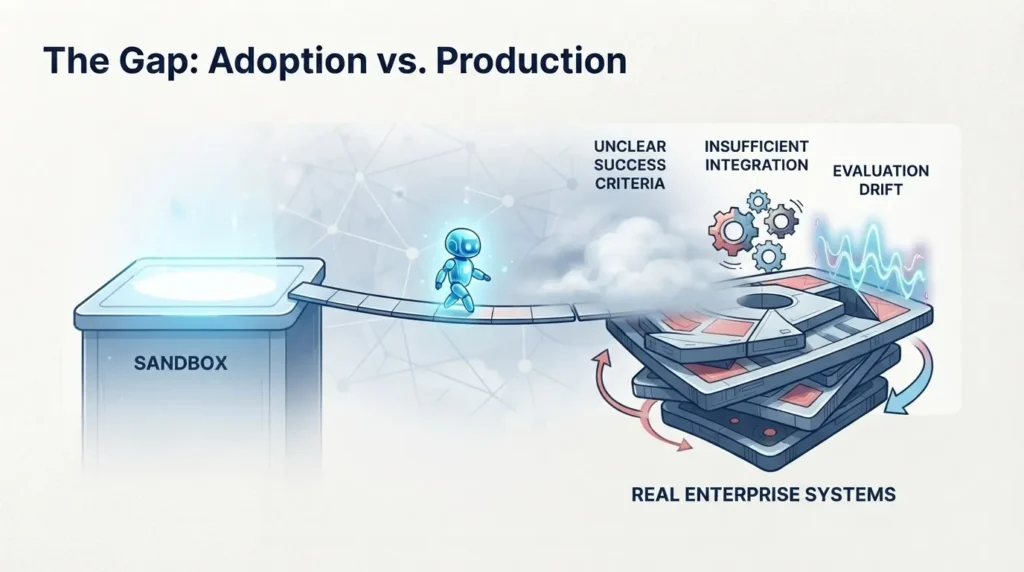
Forrester’s root-cause analysis of failed deployments attributes the majority of failures to three factors, none of which involve model quality.
-
- Unclear success criteria: Close to half of failures trace back to a pilot that was never given a measurable definition of “working.” Without a target, there’s no basis for deciding it’s ready to scale, or for deciding it’s failing and should be killed.
- Insufficient tool or data access: A third of failures come from agents that performed well in a sandbox against mocked or snapshotted data, then hit real CRM, ERP, and API connectivity in production and couldn’t function the same way. The orchestration logic was rarely the hard part; the integration depth was.
- Evaluation drift: The rest trace to agents that passed initial testing but had no ongoing evaluation harness to catch quality degradation as data, prompts, or downstream systems changed after launch.
Underneath all three sits a governance gap: only about one in five organizations report having a mature governance model for autonomous agents, and integration plus governance together are the most commonly cited barriers to moving past pilot stage.
What the Organizations That Reach Production Do Differently
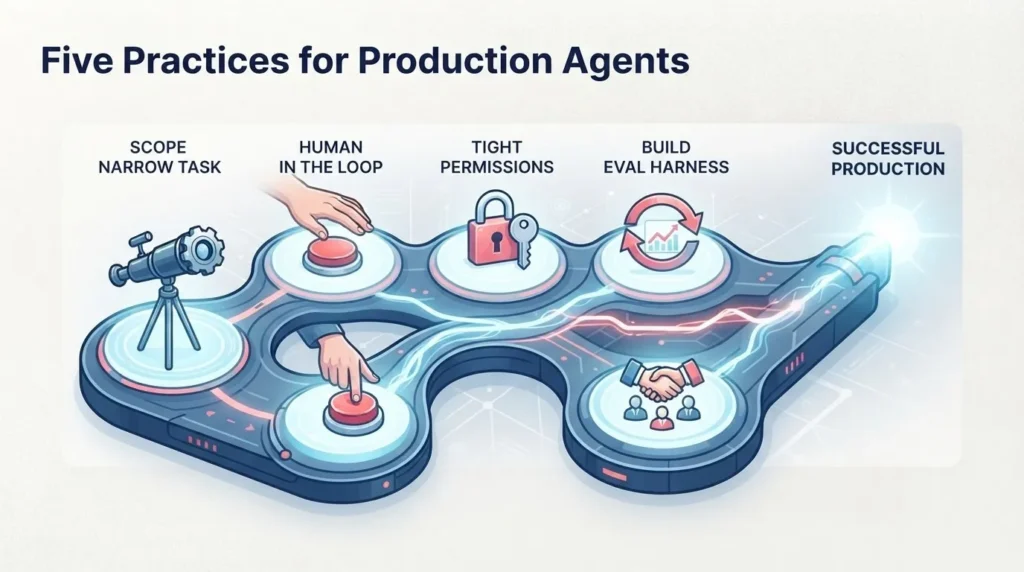
Across the research, the same five practices separate agents that scale from agents that stall.
-
- Scope a narrow, high-volume task first: The fastest, most reliable results come from workflows that are repetitive, rule-rich, and high-volume, not broad or judgment-heavy. Customer service and support workflows typically show measurable impact within a couple of months; open-ended orchestration across supply chain or operations can take a year or more to prove out.
- Keep a human in the loop on risky steps: Full autonomy from day one is rarely the goal. Production-grade agents keep a human checkpoint on any action that’s high-stakes, irreversible, or customer-facing, and expand autonomy only as the evaluation data supports it.
- Lock down permissions tightly: Agents that reach production are scoped to the minimum access their task requires, not the broad access their parent system happens to have. Loose permissions are a security and reliability liability long before they’re an ethics problem.
- Build the evaluation harness before scaling, not after: Automated evaluation against real (not mocked) data is what catches quality drift before users do, and it’s the evidence that proves the agent is still performing at the standard that justified the investment of time and effort.
- Name an owner and train the team that inherits the agent: The team that builds a pilot is rarely the team that operates it long-term. Production deployments assign clear ownership and invest in training the operating team, not just the build team, before handoff.
A Practical Path from Pilot to Production
-
- Build the workflow, scoped narrow: Pick one repetitive, high-volume, measurable task. Define success criteria and a kill threshold before writing any code.
- Integrate against real systems early: Connect to live (or realistic, non-mocked) CRM, ERP, and API data as early as possible in the pilot, since integration depth is where most projects stall later.
- Deploy governance in parallel, not after: Permissions, human checkpoints, and audit logging should ship alongside the workflow, not get retrofitted once the pilot “works.”
- Launch in controlled scope: Roll out to a limited user group or transaction volume first, with the evaluation harness active from day one.
- Expand only on evaluation evidence: Scale scope, autonomy, or volume based on what the evaluation data shows, not on a fixed calendar milestone.
Enterprises following roughly this sequence report reaching production within about six months. Each subsequent agent typically deploys faster, since the governance and evaluation infrastructure built for the first one is reusable.
Plan for the Real Scope, Not Just the Pilot Scope
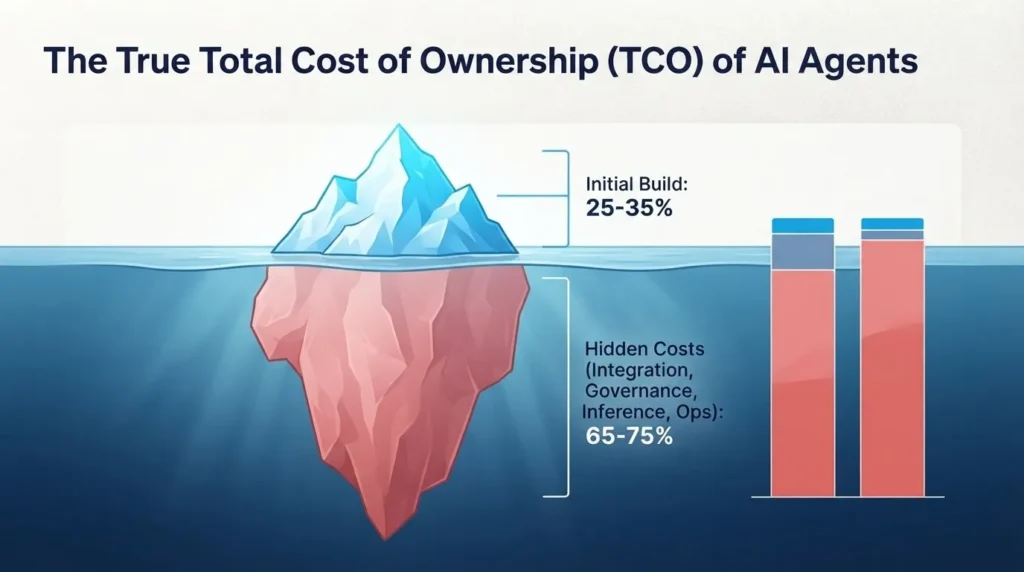
One more pattern worth planning around: the median enterprise significantly underestimates the full scope of work a production agent deployment requires over its lifetime. Initial build is only a fraction of that total effort. The rest accumulates in system integration, ongoing operational maintenance, governance tooling, and change management — all the things a pilot plan usually doesn’t account for. Planning for production from the start, rather than re-planning after the pilot succeeds, is one of the simplest ways to avoid stalling at the handoff point.
How Kernshell Helps
Kernshell works with enterprise teams to take agentic AI initiatives past the pilot stage: scoping high-value workflows, building the integration layer against real production systems, and standing up the governance and evaluation infrastructure that separates a working demo from a production system. That spans AI Consulting for strategy and workflow selection, AI Agents & Automation for build and integration, and MLOps for the monitoring and evaluation harness that keeps agents reliable after launch. If you have a pilot that’s stalled, or you’re scoping your first one, we can help you build it to reach production the first time.