




















Best AI Solutions for Healthcare Operations
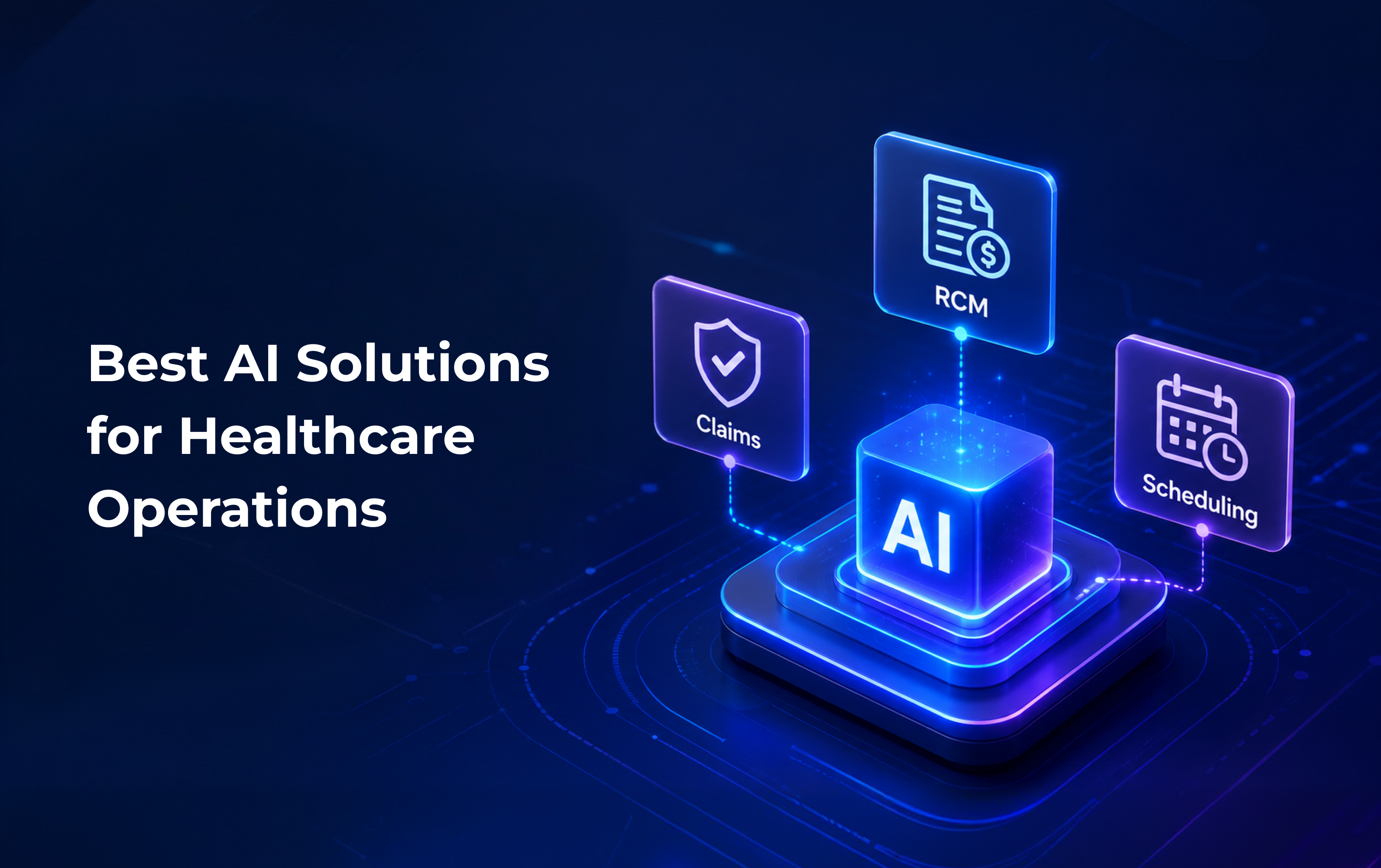
Healthcare organizations are under mounting pressure: rising operational costs, staff shortages, complex payer requirements, and growing patient volumes. Artificial intelligence is rapidly becoming the answer, not as a futuristic concept, but as a practical tool deployed across revenue cycle management (RCM), claims processing, and patient scheduling today.
This article explores the best AI solutions for healthcare operations in 2026, what they do, and why they matter for hospitals, clinics, and healthcare systems of every size.
Why AI in Healthcare Operations – And Why Now?
Administrative inefficiencies cost the U.S. healthcare system an estimated $265 billion annually. A significant portion of that waste comes from manual processes in billing, claims, and scheduling. AI addresses this directly by automating repetitive tasks, reducing errors, predicting outcomes, and enabling staff to focus on higher-value work.
Key drivers of AI adoption in healthcare operations include:
-
- Growing claim denial rates (averaging 5–10% across U.S. providers)
- Prior authorization bottlenecks slowing patient care
- No-show rates disrupting scheduling efficiency
- Staff burnout from high administrative workloads
AI in Revenue Cycle Management (RCM)
Revenue cycle management is one of the highest-impact areas for AI in healthcare. The RCM lifecycle – from patient registration and coding to claim submission and payment posting – involves dozens of manual touchpoints, each prone to error.
Top AI Capabilities in RCM:
-
- Predictive Denial Management
AI models analyze historical claim data to predict which claims are likely to be denied before they’re submitted. This allows billing teams to proactively correct issues, reducing denial rates by up to 40%. - Automated Medical Coding (AI-Assisted CDI)
Natural language processing (NLP) reads clinical documentation and suggests accurate ICD-10 and CPT codes, reducing coding errors and audit risk. Tools like Nuance’s AI-powered CDI suite and Artifact Health are leading this space. - Intelligent Charge Capture
AI scans clinical notes and EHR entries to identify missing or under-coded charges, helping providers capture revenue they would otherwise leave on the table. - Payment Prediction & Cash Flow Forecasting
Machine learning models forecast which accounts are likely to pay, the expected payment timeline, and which accounts need escalated follow-up — enabling smarter prioritization for AR teams.
- Predictive Denial Management
Leading RCM AI Platforms (2026):
-
- Waystar — AI-powered claims management and denial prevention
- Ensemble Health Partners — End-to-end RCM with AI automation
- Olive AI (now integrated into broader platforms) — Workflow automation across RCM
- Change Healthcare (Optum) — Claims clearinghouse with ML-driven analytics
AI in Claims Processing
Insurance claims processing is ripe for AI transformation. A typical claim passes through multiple review, validation, and adjudication steps — most of which can be automated or accelerated with AI.
Key AI Applications in Claims:
-
- Automated Claims Intake & Validation
AI extracts structured data from unstructured claim forms, EOBs, and medical records using OCR and NLP — reducing manual data entry and speeding up processing times from days to hours. - Fraud, Waste & Abuse Detection
AI models identify suspicious billing patterns, duplicate claims, and anomalies that human reviewers might miss. This is especially valuable for payers and TPAs managing high claim volumes. - Prior Authorization Automation
One of the most time-consuming steps in claims, prior auth can be significantly accelerated by AI tools that cross-reference clinical criteria and payer guidelines in real time. Companies like Cohere Health and Myndshft are making major strides here. - Claims Routing & Prioritization
AI intelligently routes claims to the right processing queues based on complexity, payer type, and urgency — reducing bottlenecks and improving throughput.
- Automated Claims Intake & Validation
AI in Patient Scheduling
Patient scheduling inefficiency costs healthcare systems millions annually through no-shows, underutilized slots, and staff overtime. AI is transforming how appointments are booked, managed, and optimized.
Top AI Scheduling Capabilities:
-
- No-Show Prediction & Prevention
AI models analyze patient history, demographics, appointment type, and external factors to predict no-show likelihood. Automated reminders and rescheduling nudges are then triggered for high-risk patients, reducing no-show rates by 20–30%. - Intelligent Slot Optimization
Rather than static templates, AI dynamically adjusts scheduling templates based on provider availability, patient acuity, historical patterns, and real-time cancellations — maximizing utilization. - Conversational AI for Appointment Booking
AI-powered chatbots and voice assistants allow patients to book, reschedule, or cancel appointments 24/7 without staff involvement. Platforms like Luma Health, Hyro, and Nuance Dragon Ambient eXperience are leaders here. - Care Gap Closure & Outreach
AI identifies patients overdue for preventive screenings or follow-up visits and automatically triggers outreach — helping close care gaps and driving appointment volume.
- No-Show Prediction & Prevention
Choosing the Right AI Solution for Your Healthcare Organization
When evaluating AI platforms for healthcare operations, consider:
-
- EHR Integration — Does the solution integrate natively with Epic, Cerner, or your existing systems?
- HIPAA Compliance — Non-negotiable. All AI solutions must meet data privacy and security standards.
- Scalability — Can the platform handle your current and future patient volumes?
- ROI Transparency — Look for vendors who provide clear metrics: denial rate reduction, days in AR, scheduling fill rates.
- Implementation Support — Healthcare AI requires strong onboarding and change management.
The Road Ahead
AI in healthcare operations is no longer optional for organizations looking to remain financially viable and operationally competitive. From cutting denial rates in RCM to eliminating no-shows in scheduling and accelerating claims adjudication, the ROI is measurable and growing.
The organizations investing in AI-powered operations today are building the infrastructure for sustainable, patient-centered care tomorrow.
This article was originally published on the Kernshell blog. Read the full version on Medium: Best AI Solutions for Healthcare Operations